

Position current at 30 August 2026
The European Union Deforestation Regulation is approaching, but there is an important distinction between a market-access requirement affecting particular supply chains and a new legal obligation applying directly to every Australian cattle producer.
The EUDR will apply to large and medium-sized European operators from 30 December 2026, with most smaller operators following from 30 June 2027. It covers cattle, beef and a defined list of other commodities and products placed on the European market.
Under the regulation, these products must be deforestation-free, produced in accordance with the relevant laws of their country of production and supported by traceability and geolocation information.
That makes EUDR important to Australian beef supply chains serving Europe. However, it does not mean that every Australian beef or dairy producer must obtain a private deforestation assessment.
Who carries the legal obligation?
The European Commission states that the EUDR does not impose direct obligations on producers in non-EU countries unless they are directly placing products on the European market.
The legal responsibility generally rests with the European operator placing the product on the market. That operator must collect the required information, complete the appropriate due-diligence process and submit a due-diligence statement before the product enters the EU.
Australian producers, feedlots, processors and exporters may be asked to provide information that allows the European operator to meet this obligation. This can include the origin of the product, production dates, evidence of compliance with Australian laws and the geolocation of the establishments where cattle were kept.
An Australian producer supplying this information is supporting the European operator’s due diligence. The producer is not ordinarily responsible for submitting the European due-diligence statement.
Australia has been classified as low risk
In May 2025, the European Commission classified Australia as a low-risk country under the EUDR.
This allows operators sourcing products produced entirely in Australia and other low-risk countries to use simplified due diligence, provided those products have not been mixed with products of unknown, standard-risk or high-risk origin.
The operator must still collect information demonstrating compliance. However, it does not normally have to undertake the full risk-assessment and risk-mitigation process unless information emerges suggesting that a product may not comply.
The Australian Department of Agriculture, Fisheries and Forestry reports that 1% of importers placing regulated goods exclusively from low-risk countries will be subject to annual checks, compared with 3% for standard-risk and 9% for high-risk origins.
The low-risk classification therefore reduces the regulatory burden, but it does not remove the need for traceability or geolocation information.
What is required from cattle producers?
For cattle, the EUDR requires a geolocation for each establishment where an animal has been kept. The Australian Department of Agriculture describes this as at least one latitude and longitude coordinate, recorded to six decimal places, for each establishment.
The Australian red meat industry has developed a way to share this information through the Livestock Production Assurance program.
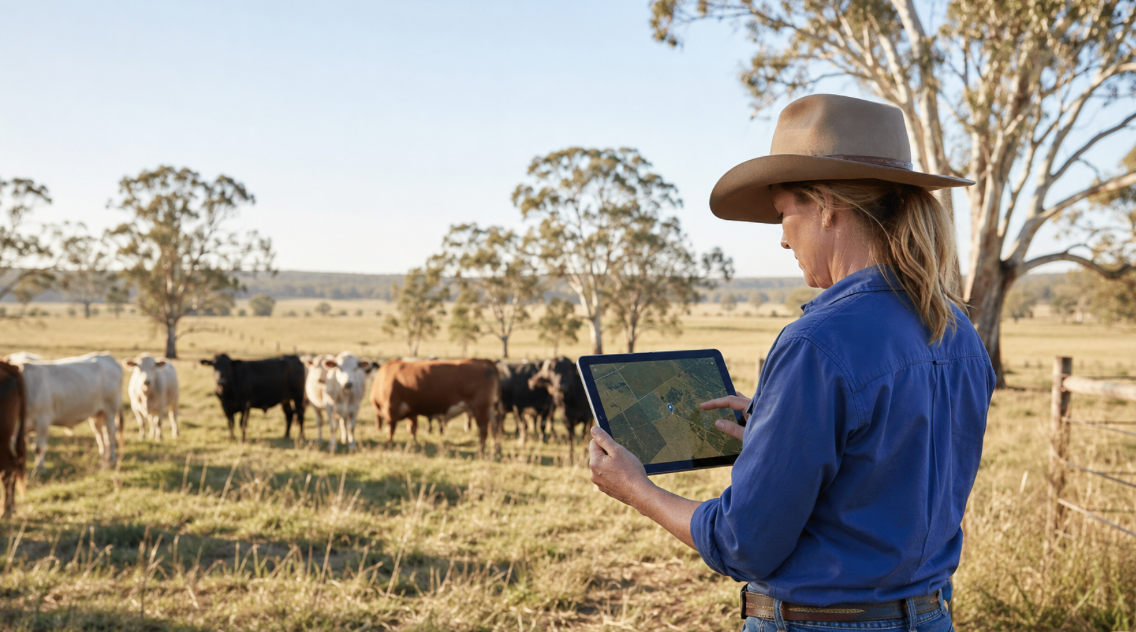
LPA-accredited producers can enter a single geolocation for their property and consent to that information being shared through the National Livestock Identification System. Feedlots and processors involved in European supply chains can then use an animal’s NLIS identification to retrieve available geolocations from its movement history and pass the information through the supply chain.
Integrity Systems Company makes several points about this process:
participation in geolocation sharing is voluntary;
producers who want their cattle to remain available to European supply chains should provide the information;
the geolocation tool does not itself determine whether deforestation has occurred;
processors and European importers use the information to undertake the required checks; and
PICs, producer names and other personal information are not shared through the report.
Cattle Australia has also encouraged EUCAS-accredited producers to provide their geolocation through LPA so cattle retain access to European supply chains and any associated market premiums.
For a producer already participating in the European Union Cattle Accreditation Scheme, sharing the property geolocation is therefore the immediate practical action. A producer who chooses not to share it may find that cattle are no longer eligible for an EU program.
For producers outside EUCAS and with no connection to a European supply chain, there is no blanket EUDR requirement to obtain a property assessment. They may still choose to share their geolocation to preserve future market flexibility or because a buyer requests it.
What does EUDR mean for dairy producers?
Milk and dairy products are not included in the products covered by the EUDR. The regulation therefore does not impose an EUDR requirement on the production of Australian milk, cheese, butter or milk powder.
A dairy animal could become relevant if it enters a cattle or beef supply chain intended for the EU. In that case, the issue relates to the animal and the resulting beef product, rather than to the milk produced by the dairy enterprise.
Earlier industry communications also encouraged participation by cattle producers outside EUCAS because Australian hides and leather could enter European markets regardless of whether the beef was EU eligible.
That position is changing. On 13 July 2026, the European Commission adopted a delegated regulation removing cattle hides, skins and leather from the EUDR product list. The delegated regulation has been sent to the European Parliament and the Council of the EU for scrutiny before entering into force.
If the amendment takes effect, it removes the main basis for claiming that every Australian cattle property is exposed to EUDR through the hide market. Cattle and beef intended for European consumption will remain covered.
Some older Australian industry information still refers to the previous 2025 commencement date and to hides and leather remaining within scope. Those materials should be read alongside the more recent European Commission and Department of Agriculture updates.
Is a private farm assessment required?
Neither the EUDR nor the current Australian industry process requires every producer to purchase a private farm deforestation assessment.
The European Commission’s 2026 guidance is explicit that the EUDR does not oblige operators to use a certification or third-party verification scheme, does not require producers to sign up to one and does not require producer countries to develop such schemes.
Using third-party verification is a voluntary decision by the European operator. It may provide supporting evidence, but it does not replace the operator’s legal responsibility for due diligence or automatically create an approved pathway into the market.
The Australian Department of Agriculture also states that the EUDR does not require the use of any particular map. It identifies several third-party information sources that may help an importer, but cautions that the Australian Government cannot guarantee their relevance or acceptance by European authorities.
This does not mean an additional assessment has no value. It may be useful where:
vegetation change has been identified by satellite mapping;
clearing or significant vegetation management has occurred since 31 December 2020;
a processor or importer requests further evidence;
the producer believes an external map has incorrectly classified part of the property; or
the value of retaining EU eligibility justifies resolving uncertainty before cattle are purchased.
In those situations, an assessment can help investigate a specific question. It should not be presented as an automatic requirement for every Australian beef or dairy producer.
What should producers do now?
EUCAS-accredited producers should log into their LPA account, check their property details and consider opting into the geolocation-sharing function. Accurate NLIS transfers will also remain important because European supply chains need to identify the establishments where cattle have been kept.
Producers who are not part of an EU supply chain should ask their buyer, feedlot or processor whether a request relates to EUDR, a company procurement policy or a separate voluntary sustainability program. These may involve different standards and should not be treated as interchangeable.
Dairy producers do not need to take action in relation to milk production under the EUDR. If a buyer requests information for cull cows or other cattle, the producer should establish whether those animals are intended for an EU beef pathway.
Where relevant vegetation change has occurred since the end of 2020, producers intending to retain EU access should keep records of approvals, maps, land-use history and the purpose of the work. Compliance with Australian law and the EUDR deforestation-free requirement are related but separate tests, so legal clearing under state legislation should not automatically be assumed to satisfy every EU market requirement.
EUDR is a significant issue for the Australian businesses servicing the European beef market. For most producers, however, the immediate requirement is much narrower than some of the broader messaging suggests: understand whether cattle are likely to enter an EU supply chain, maintain accurate NLIS records and, where appropriate, share the property geolocation through LPA. Further assessment should be considered when there is a specific risk or market request, rather than simply because the regulation exists.
References
European Commission. Regulation on Deforestation-free Products.
European Commission. Countries and partnerships: EUDR obligations and country risk classifications.
European Commission. Guidance Document for the Regulation on Deforestation-Free Products, 2026.
European Commission. Commission updates product scope and digital tools to support EUDR implementation, 13 July 2026.
EUR-Lex. Consolidated text of Regulation (EU) 2023/1115 and Annex I product list.
Australian Department of Agriculture, Fisheries and Forestry. European Union Deforestation Regulation: current Australian guidance.
Integrity Systems Company. LPA EUDR and geolocation-sharing resources.
Meat & Livestock Australia. Australian Beef Sustainability Framework welcomes Australia’s low-risk classification.
Cattle Australia. Industry advice on EU eligibility and the LPA geolocation tool.
This article provides general information based on the position current at 30 August 2026. Producers supplying an EU market should confirm requirements with their processor, exporter or market program.